Tongue-palate contact patterns for English consonants
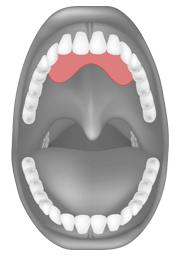
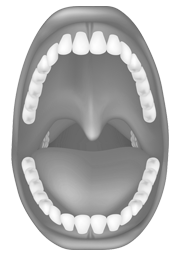
Discover where the tongue touches the alveolar ridge, hard palate and soft palate when producing English consonants. Diagrams show the tongue-palate contact pattern for each sound, with short videos showing how the sound is produced.

Go beyond the tongue-palate diagram
This page shows typical tongue-palate contact patterns for each sound, but it cannot show the tongue moving in real time or tell you whether you are producing a sound correctly. Pronunciation Coach 3D lets you type any English word or sentence and watch a 3D model of the tongue, lips and airflow shape each sound, then record yourself and get an instant pronunciation score.
See how Pronunciation Coach 3D works →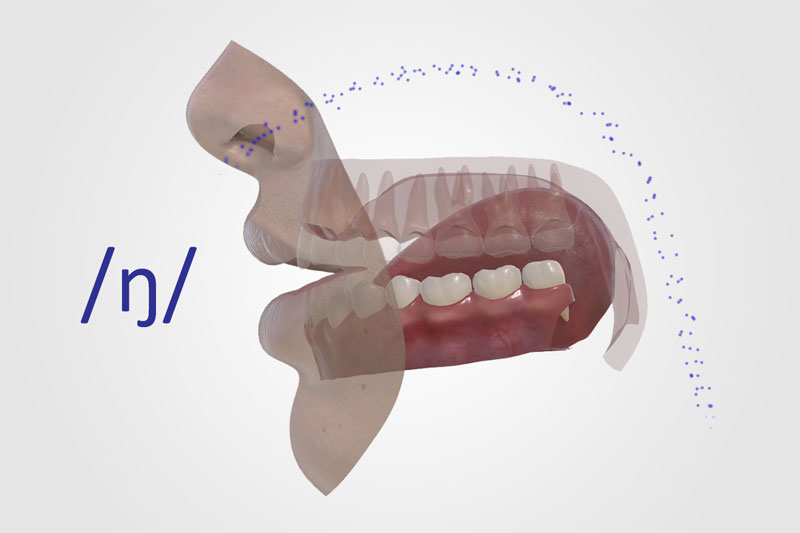
Frequently asked questions
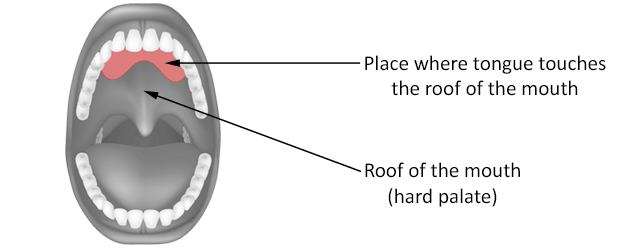
The roof of the mouth has three main parts, moving from front to back: the alveolar ridge, just behind the upper front teeth; the hard palate, the firm bony section in the middle; and the soft palate, or velum, the softer section at the back. Together, these surfaces are contacted by the tongue to produce many English consonants.
A palatal consonant is a sound made with the body of the tongue raised toward the hard palate. In English, the clearest example is /j/, as in yes, although the tongue usually approaches the hard palate rather than making firm contact, which is why it is not shown in the diagrams above. Some sounds, such as /ʃ/ as in shut and /ʒ/ as in vision, are made further forward, between the alveolar ridge and the hard palate, and are often described as post-alveolar or palato-alveolar rather than fully palatal.
English has very few true palatal consonants. The main example is /j/, as in yes, where the tongue approaches the hard palate without forming a firm closure. Sounds that are sometimes loosely called palatal, such as /ʃ/ as in shut and /ʒ/ as in vision, are usually described more precisely as post-alveolar or palato-alveolar because they are made slightly further forward, between the alveolar ridge and the hard palate. True palatal consonants are more common in other languages, where sounds such as /ɲ/ or /c/ involve closer contact with the hard palate.
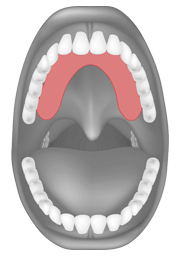
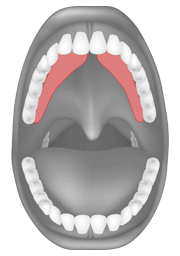
Several English consonants are made at the alveolar ridge, just behind the upper front teeth. /t/, /d/ and /n/ are made with the tongue tip forming a closure against the ridge. /l/ is also made with the tongue tip touching the ridge, but air flows around the sides of the tongue. /s/ and /z/ are made with the tongue held close to the ridge rather than fully closing against it, leaving a narrow gap for air to pass through and create a hissing sound. Diagrams for these sounds are shown above.
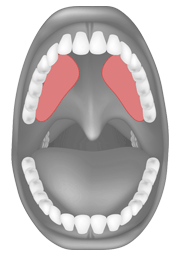
The back of the tongue touches the soft palate to make three English consonants: /k/ as in kit, /g/ as in got, and /ŋ/ as in thing. /k/ and /g/ are made with the soft palate raised, sealing off the nasal passage so that air is released through the mouth. /ŋ/ uses the same tongue-to-palate contact, but the soft palate lowers, allowing air to flow through the nose. This is what makes /ŋ/ a nasal sound as well as a velar one. Diagrams for these sounds are shown above.
Yes. Several English consonants are made without the tongue touching the roof of the mouth. /p/, /b/ and /m/ are made at the lips, rather than with the tongue against the palate. /f/ and /v/ are made with the lower lip against the upper teeth, and /θ/ as in thin and /ð/ as in this are made with the tongue against or between the teeth. None of these sounds involve tongue-palate contact, which is why they are not included in the diagrams above.
Electropalatography, or EPG, is a technique that captures tongue-palate contact patterns during speech using a custom-made EPG palate with 62 electrodes embedded on its surface. The diagrams on this page were derived from electropalatography data and show typical tongue-palate contact patterns for each sound. Speech researchers and professionals who need to capture contact patterns directly, including from their own speakers, can use dedicated EPG hardware such as icSpeech's LinguaGraph system.
The best way to practise is to compare your own pronunciation against a model. Pronunciation Coach 3D lets you type any English word or sentence and watch a 3D animation of the tongue, lips and airflow shape each sound, so you can see the contact pattern in motion rather than as a still diagram. You can then record yourself and get an instant pronunciation score to see how closely you matched it.