How English speech sounds are made
English speech sounds are shaped as air from the lungs passes through the throat, mouth and nose. This page introduces the main parts of the speech anatomy, including the lips, teeth, alveolar ridge, hard and soft palate, tongue and vocal folds, with short videos showing how the sounds are made.


Hard Palate
The hard palate is the hard part of the roof of the mouth.
Sounds that are made with the hard palate are called palatal sounds, for example /j/.

Soft Palate (velum)
The soft palate or velum is the soft portion of the roof of the mouth, lying behind the hard palate. The velum performs two important roles in speech:
- The tongue body touches the velum in order to make the sounds /k/, /g/, and /ŋ/.
- Normally during speech, the velum is in its raised position, blocking off airflow through the nose. But during some sounds (the nasal sounds, such as /m/, /n/, and /ŋ/) it lowers and allows air to flow through the nose.
Sounds that are made with the velum are called velar sounds.

Pharynx
The pharynx is a resonating cavity or chamber lying above the larynx and posterior to the oral cavity.

Vocal Folds
The vocal folds, also known commonly as vocal cords, are composed of twin infoldings of mucous membrane stretched horizontally across the larynx. They vibrate, modulating the flow of air being expelled from the lungs during phonation.
Sounds that are made with the vibrating vocal folds are called voiced sounds.

Tongue Tip (apex)
The tip of the tongue is thin and narrow, it is directed forward against the lingual surfaces of the upper incisor teeth.
Sounds that are made with the tongue tip are called apical sounds.

Tongue Blade
The blade is the part of the tongue lying just below the upper alveolar ridge.
Sounds which are made with the tongue blade are called laminal sounds.

Tongue Back
The tongue back is that part of the tongue lying below the soft palate.
Sounds that are made with the tongue back are called dorsal sounds.
Go beyond the anatomy diagram
This page shows where each English sound is made, but it cannot show the anatomy moving in real time or tell you whether you are producing a sound correctly. Pronunciation Coach 3D lets you type any English word or sentence and watch a 3D model of the tongue, lips and airflow shape each sound, then record yourself and get an instant pronunciation score.
See how Pronunciation Coach 3D works →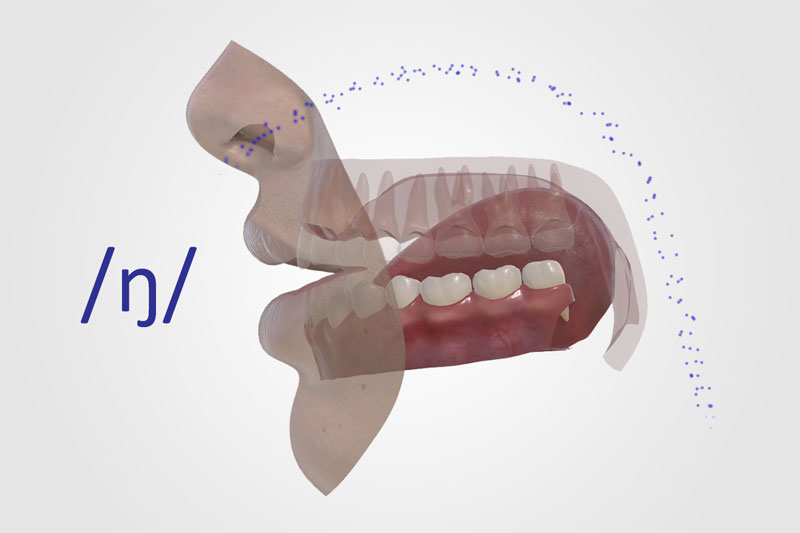
Frequently asked questions
The main organs of speech are the parts of the body used to shape sound as air from the lungs passes through the vocal tract. They include the lips, teeth, alveolar ridge, hard palate, soft palate, tongue, pharynx and vocal folds. The vocal folds create voicing for some sounds, while the lips, tongue, teeth and palate shape the airflow into the individual sounds of speech. Sounds are often named after the part of the speech anatomy used to make them, such as labial sounds at the lips and dental sounds at the teeth.
Different speech sounds are made at different places in the vocal tract. These locations are known as the places of articulation. Sounds made at the lips, such as /p/, /b/ and /m/, are labial. Sounds made with the teeth, such as /θ/ and /ð/, are dental. Sounds made at the alveolar ridge behind the upper teeth, such as /t/, /d/, /s/, /z/, /n/ and /l/, are alveolar. Sounds made at the hard palate, such as /j/, are palatal, and sounds made at the soft palate, such as /k/, /g/ and /ŋ/, are velar.
The alveolar ridge is the ridge of gum just behind the upper front teeth, where the angle of the roof of the mouth changes. Sounds made with the tongue at or near this ridge are called alveolar sounds. In English, these include /t/, /d/, /s/, /z/, /n/ and /l/.
The hard palate is the firm, bony front part of the roof of the mouth, while the soft palate, or velum, is the soft section behind it. Sounds made with the hard palate are called palatal sounds, such as /j/, and sounds made with the soft palate are called velar sounds, such as /k/, /g/ and /ŋ/. The soft palate also acts as a valve: it raises to block airflow through the nose for oral sounds, and lowers for nasal sounds to let air flow out through the nose.
The tongue is the most mobile of the speech organs, and different parts of it are used for different sounds. The tip, or apex, is the thin front edge of the tongue and is used for apical sounds. The blade is the part just behind the tip and is used for laminal sounds. The back of the tongue, or dorsum, lies below the soft palate and is used for dorsal sounds, including velar sounds such as /k/ and /g/.
Speech production is often described in four stages. Respiration is the airflow from the lungs that powers speech. Phonation is the vibration of the vocal folds in the larynx, which creates voicing for sounds such as vowels and voiced consonants. Resonance is the way the sound is shaped and amplified as it passes through the pharynx, mouth and nose. Articulation is the final shaping of the airflow by the lips, teeth, tongue and palate into individual speech sounds.
The difference is whether the vocal folds vibrate. Voiced sounds are made with the vocal folds vibrating, such as /b/, /d/, /g/, /v/, /z/ and all vowel sounds. Unvoiced, or voiceless, sounds are made with the vocal folds held open and not vibrating, such as /p/, /t/, /k/, /f/ and /s/. You can feel the difference by placing a hand on your throat: voiced sounds produce a vibration, while unvoiced sounds do not.
The soft palate, or velum, controls whether air flows through the mouth or the nose. For most speech sounds it is raised, closing off the nasal passage so that air flows out through the mouth. For nasal sounds, such as /m/, /n/ and /ŋ/, the soft palate lowers and allows air to flow through the nose. This movement is what separates oral sounds from nasal sounds.
The sound links on this page open short videos showing how different English sounds are produced. To go further, Pronunciation Coach 3D lets you type any English word or sentence, watch an animated 3D model of the mouth showing how the tongue, lips and airflow shape each sound, then record yourself and get an instant pronunciation score.
The best way to improve is to practise and compare. Pronunciation Coach 3D records your speech and displays it alongside an animated 3D model of the mouth, so you can compare your pronunciation with the model. It also gives a speech intelligibility score, showing how clearly your speech was understood.