Super Nasal-Oral Ratiometry System
SNORS is a portable, USB-powered nasal-oral airflow system that provides an objective measure of velopharyngeal closure by measuring aerodynamic nasalance, defined as the percentage of the total airflow that is nasal during speech. It uses a lightweight dual-chamber mask, fitted with rapid-response airflow sensors and microphones for independent nasal and oral measurement. SNORS is used by speech and language professionals and researchers in specialist hospitals, university programmes, and cleft palate services worldwide.
How SNORS measures velopharyngeal closure
Unlike traditional anemometry, which measures only nasal airflow, SNORS measures both nasal and oral airflow simultaneously. By calculating the ratio of nasal to total airflow, SNORS reduces sensitivity to variations in speech loudness and produces more consistent measurements across different speakers and tasks. SNORS also uses rapid-response airflow sensors capable of tracking the fast movements of the velum during speech.
Aerodynamic vs acoustic nasalance
Aerodynamic nasalance provides a measure of effective velopharyngeal closure, whereas acoustic nasalance (defined as the percentage of the total acoustic energy that is nasal, and often referred to simply as nasalance) relates to the perceived nasality of speech. Both measures are useful and complementary.

Aerodynamic nasalance has practical advantages over acoustic nasalance measurement. Unlike acoustic nasalance, it is not affected by resonant frequencies, acoustic crossover or background noise, and can be calculated for both voiced and unvoiced sounds. Crucially, aerodynamic nasalance is near zero when velopharyngeal closure is maintained, regardless of nasal cavity resonance or vowel context. Interpretation is therefore more straightforward than acoustic nasalance.
| Phoneme | Aerodynamic nasalance (%) | Acoustic nasalance (%) |
|---|---|---|
| /i/ (High vowel) | 1.68 | 12.56 |
| /ɑ/ (Low vowel) | 2.01 | 5.23 |
| /m/ | 99.87 | 97.04 |
| /n/ | 99.86 | 96.14 |
| /ŋ/ | 98.92 | 97.15 |
| /s/ | 2.26 | N/A |
| /p/ | 3.28 | N/A |
Aerodynamic nasalance measured with SNORS; acoustic nasalance measured with the Nasality Microphone. Values from a single normal English-speaking adult.
SNORS mask
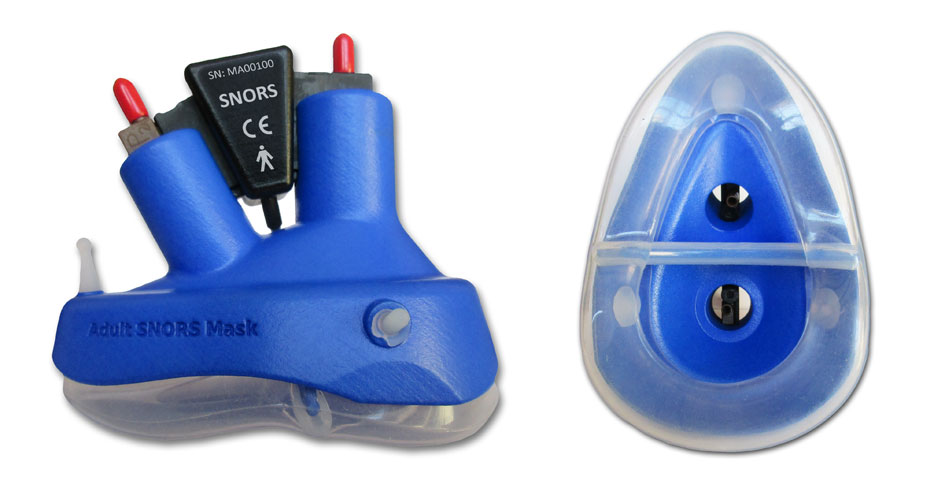
- Lightweight dual-chamber mask separates nasal and oral signals
- Soft silicone cuff moulds to the contours of the face for a comfortable airtight seal
- Rapid-response airflow sensors detect the fast movements of the velum during speech
- Nasal and oral microphones record nasal and oral speech signals for acoustic analysis
- Adult and child (4+) sizes available
- Child mask available in a range of colours
SNORS processor unit
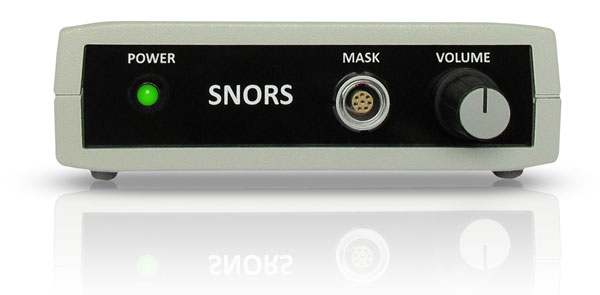
- Quick-release connector for interchangeable adult and child masks
- Volume control for optimised audio recording levels
- Auxiliary channel for simultaneous recording from external devices
- USB powered — no external power supply required
- Connects to any Windows desktop, laptop, or tablet
Who uses SNORS
SNORS is used by speech and language professionals and researchers in specialist hospitals, university programmes, and cleft palate services worldwide to obtain an objective measure of velopharyngeal closure across a wide range of speakers and populations.
Why speech professionals choose SNORS
- ✓ Unambiguous velopharyngeal closure measurement — aerodynamic nasalance approaches zero when velopharyngeal closure is maintained, regardless of nasal cavity resonance or vowel context, making it more straightforward to interpret than acoustic nasalance.
- ✓ No acoustic interference — unlike acoustic nasalance measurement, aerodynamic nasalance is not affected by resonant frequencies, acoustic crossover, or background noise.
- ✓ Measures voiced and unvoiced sounds — aerodynamic nasalance can be calculated for both voiced and unvoiced sounds, unlike acoustic nasalance which is limited to voiced sounds only.
- ✓ Simultaneous aerodynamic and acoustic recording — captures nasal and oral airflow alongside speech signals in a single lightweight, USB-powered system.
- ✓ Adult and child sizes — interchangeable adult and child masks with a quick-release connector, suitable for speakers aged 4 and above.
- ✓ Compatible software — works with SNORS 3D and icSpeech Professional Edition, with real-time nasal-oral airflow displays, 3D velopharyngeal visualisation, biofeedback games, and offline analysis.
- ✓ Published research — described in peer-reviewed literature and used in published studies investigating velopharyngeal function, nasal-oral airflow, and hypernasality.
- ✓ Trusted worldwide — used by universities, hospitals, and research institutions worldwide, built on nearly 40 years of speech technology development.









- Aarhus University
- University of Florida
- Laboratoire de Phonétique et de Phonologie
- University of Cyprus
- Osaka Health Science University
- Moor House School and College
- Penn Medicine
- Fundacja Rozszczepowe Marzenia
- Smile House Fondazione
Software options
SNORS 3D
SNORS 3D uses an animated 3D model of the vocal tract to illustrate velopharyngeal closure and the resultant nasal and oral airflows. Nasal airflow, oral airflow, and aerodynamic nasalance are also displayed numerically.


The animated 3D model consists of the lips, teeth, tongue, lower jaw, hard palate, soft palate and uvula. The transparency of these articulators can be adjusted to reveal hidden structures, and the model can be rotated 360°. Airflow illustrates the difference between nasal, oral, voiced and voiceless sounds.
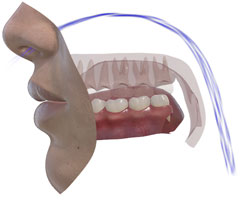
Nasal airflow (soft palate lowered)
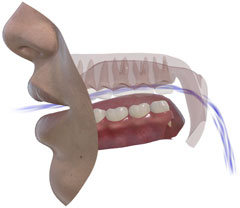
Oral airflow (soft palate raised)
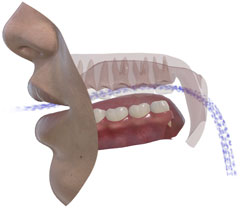
Voiced airflow (intermittent flow)
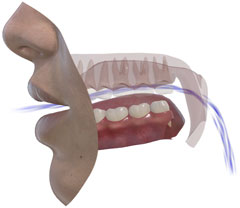
Voiceless airflow (continuous flow)
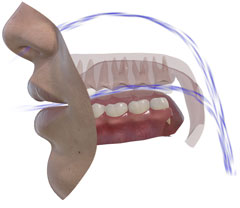
Exhalation (blue flow)
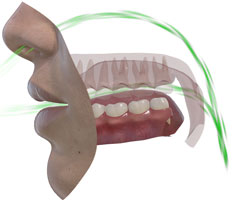
Inhalation (green flow)
- Real-time visual feedback of velopharyngeal closure
- Off-line analysis of aerodynamic nasalance
- Auditory playback of recorded speech
- Photorealistic and stylised views
- 360° model rotation
- Adjustable articulator transparency
- Windows 10 64-bit and 11 64-bit compatible
icSpeech Professional Edition
icSpeech Professional Edition is a comprehensive speech visualisation and analysis package that significantly extends the capability of SNORS, providing a wider range of aerodynamic and acoustic displays, data recording, and biofeedback games. It also supports multiparameter recording, allowing airflow data to be combined with electropalatography (EPG), electroglottography (EGG), nasometry, and video.


- Aerodynamic and acoustic displays including waveforms, dynamic bar charts and spectrograms
- Data recorder with picture and text prompting — import or create custom prompts
- Six biofeedback games with adjustable targets and rewards
- Compare multiple recordings simultaneously
- Export raw data to CSV for external processing
- Attach user notes to recordings
- Windows 10 and 11 compatible
icSpeech Professional Edition provides the following SNORS parameters:
| Parameter | Description |
|---|---|
| Nasal airflow | Unfiltered nasal airflow signal |
| Nasal airflow intensity | Low pass filtered nasal airflow envelope |
| Oral airflow | Unfiltered oral airflow signal |
| Oral airflow intensity | Low pass filtered oral airflow envelope |
| Combined airflow | Combined nasal and oral airflow |
| Combined airflow intensity | Low pass filtered combined airflow envelope |
| Aerodynamic nasalance | Percentage of the total airflow that is nasal |
| Aerodynamic ratio | Ratio of the difference between nasal and oral airflow to the total airflow |
| Nasal speech | Nasal acoustic signal |
| Nasal speech intensity | Low pass filtered nasal speech envelope |
| Oral speech | Oral acoustic signal |
| Oral speech intensity | Low pass filtered oral speech envelope |
| Speech | Combined nasal and oral acoustic signal |
| Speech intensity | Low pass filtered speech envelope |
| Pitch | Derived from the combined acoustic signal |
| Acoustic nasalance* | Percentage of the total acoustic energy that is nasal |
| Auxiliary | Signal derived from user defined auxiliary channel |
* Acoustic nasalance measured by SNORS is less accurate than that measured by the Nasality Microphone, due to the limited acoustic separation achievable within the mask.
Video guides
This presentation introduces SNORS and provides an overview of its key features, mask design, and compatible software options.
System specification
Microphones
| Parameter | Value |
|---|---|
| Left channel | Nasal speech |
| Right channel | Oral speech |
| Type | Electret condenser |
| Polar pattern | Cardioid |
| Frequency response | 100 – 15,000Hz |
| Sensitivity | -60dB at 1kHz (0dB = 1V/Pa) |
| Output impedance | 2.2k ohm |
| Supply voltage | +2.5V |
Airflow sensors
| Parameter | Value |
|---|---|
| Maximum range (full scale) | +1000 sccm |
| Common mode pressure | 25psi |
| Response time | 3msec |
| Minimum operating temperature | -25°C |
| Maximum operating temperature | +85°C |
| Supply voltage | +10V |
Auxiliary channel
| Parameter | Value |
|---|---|
| Voltage range | ±2.5V |
| Connectivity | 50 ohm BNC Coaxial Jack |
| Acquisition sample rate | 8000 samples per second |
System requirements
| Parameter | Value |
|---|---|
| Supported operating systems | Windows 10 and 11 |
| Supported computers | Desktop, laptop, tablet |
| Connectivity | USB 1.0, 2.0, 3.0 |
| Power | USB bus powered |
Package contents
SNORS is supplied as a complete hardware package. Choose from two software options to suit your requirements.
- SNORS processor unit
- SNORS mask (adult or child)
- Locking USB cable
- User manual
- 12-month manufacturer's guarantee
- SNORS 3D software (optional)
- icSpeech Professional Edition software (optional)

Frequently asked questions
The term follows the convention established by Fletcher (1970), who coined "nasalance" to describe the ratio of nasal to total acoustic energy during speech — aerodynamic nasalance applies the same ratio principle to airflow rather than acoustic energy.
Although SNORS also records acoustic signals via microphones in both chambers of the mask, the acoustic nasalance is less accurate than that measured by the Nasality Microphone. This is due to the limited acoustic separation achievable within the mask.
SNORS, icSpeech, a division of Rose Medical Solutions Ltd., Canterbury, UK.
A list of publications featuring icSpeech technology is available on the icSpeech publications page.
While most children aged 4 and above can use the SNORS mask comfortably, some younger or anxious children may find the mask unfamiliar. In these cases, familiarising the child with the mask before measurement and using SNORS 3D's animated display as a motivational tool can help. The Nasality Microphone may be more appropriate for children who are unable to tolerate the mask.
Intended use: SNORS is a general measurement instrument for use by speech and language professionals, researchers, and educators. It is not intended for use as a medical device for the diagnosis, prevention, monitoring, or treatment of disease.