What are consonant sounds?
There are 24 consonant sounds in English. A consonant is a speech sound made by blocking or restricting airflow as it passes through the vocal tract. This is what sets consonants apart from vowels, where the air flows more freely. Most consonants release air through the mouth, while nasal sounds such as /m/, /n/ and /ŋ/ release air through the nose.
The 24 English consonant sounds fall into five main groups, shown below with example words. Each example links to a short video showing how the sound is produced.
| Group | Description | Example |
|---|---|---|
| Plosives | Sounds that cannot be sustained and which have a 'popping' quality | /p/ as in pea |
| Nasals | Sounds in which the escaping air passes through the nasal cavity | /m/ as in map |
| Fricatives | As air exits through the mouth, it forces its way through a narrowed gap to create turbulence or friction | /s/ as in so |
| Affricates | Combination sounds that begin with a complete obstruction formed by the tongue tip contacting the alveolar ridge, before the air is released slowly with friction | /ʧ/ as in chop |
| Approximants | A group of four sustainable sounds: /w/, /r/, /l/ and /j/ | /w/ as in we |
Describing consonants in more detail
As well as the five main groups above, each consonant can be described by three features: voicing, place of articulation and manner of articulation. Together, these help identify how a sound is made. For example, /p/ is a voiceless bilabial plosive. The sections below look at each feature in turn.
Voicing
Voicing is whether the vocal folds vibrate while a consonant is produced. If they vibrate, the sound is voiced; if they do not, it is voiceless. Many consonants form pairs that use the same mouth position but differ in voicing. For example, /s/ as in “so” is voiceless, while /z/ as in “zoo” is voiced. Rest a hand on your throat as you say them and you can feel the difference.
Place of articulation
Place of articulation is where in the vocal tract a consonant sound is made. It describes the point where two parts of the mouth, such as the lips, teeth or tongue, come together or move close enough to shape the airflow. There are eight main places of articulation in English:
| Place | Description | |
|---|---|---|
| 1 | Bilabial | Two lips come together |
| 2 | Labio-dental | Lower lip and upper teeth come together |
| 3 | Dental | Tongue contacts the teeth |
| 4 | Alveolar | Tongue tip moves towards the gum ridge just behind the upper incisors |
| 5 | Post-alveolar | Tongue tip is close to the position just behind the alveolar ridge |
| 6 | Palatal | Tongue moves towards the roof of the mouth (palate) |
| 7 | Velar | The back of the tongue moves towards the soft palate (velum) |
| 8 | Glottal | The only glottal consonant in English is /h/ as in how. It is made by friction as air is expelled through the gap between the vocal cords (glottis). |

Manner of articulation
Manner of articulation describes how the airflow is shaped or blocked when a consonant is produced. The five manners are the same groups introduced above: plosive, nasal, fricative, affricate and approximant. The table below summarises the 24 English consonant sounds in terms of voicing, place and manner. Click a video icon to watch a short video showing how each consonant is produced.
| Phonetic symbol | Example | Manner of articulation | Place of articulation | Video |
|---|---|---|---|---|
| /p/ | pot | plosive | bilabial |  |
| /b/ | bet | plosive | bilabial | |
| /d/ | dog | plosive | alveolar | |
| /t/ | top | plosive | alveolar | |
| /k/ | kit | plosive | velar | |
| /g/ | got | plosive | velar | |
| /f/ | fog | fricative | labio-dental | |
| /v/ | vat | fricative | labio-dental | |
| /θ/ | thick | fricative | dental | |
| /ð/ | that | fricative | dental | |
| /s/ | sat | fricative | alveolar | |
| /z/ | zoo | fricative | alveolar | |
| /ʃ/ | shut | fricative | post-alveolar | |
| /ʒ/ | measure | fricative | post-alveolar | |
| /h/ | help | fricative | glottal | |
| /ʧ/ | church | affricate | post-alveolar | |
| /ʤ/ | jump | affricate | post-alveolar | |
| /m/ | mom | nasal | bilabial | |
| /n/ | nod | nasal | alveolar | |
| /ŋ/ | thing | nasal | velar | |
| /l/ | lot | approximant | alveolar | |
| /r/ | rat | approximant | post-alveolar | |
| /w/ | won | approximant | bilabial | |
| /j/ | you | approximant | palatal | |
Go beyond these consonant sounds
This page explains each consonant sound, but it cannot show how sounds combine in words and sentences or tell you whether you are producing them correctly. Pronunciation Coach 3D lets you type any English word or sentence and see how the tongue, lips and airflow shape each sound, then record yourself and get an instant pronunciation score.
See how Pronunciation Coach 3D works →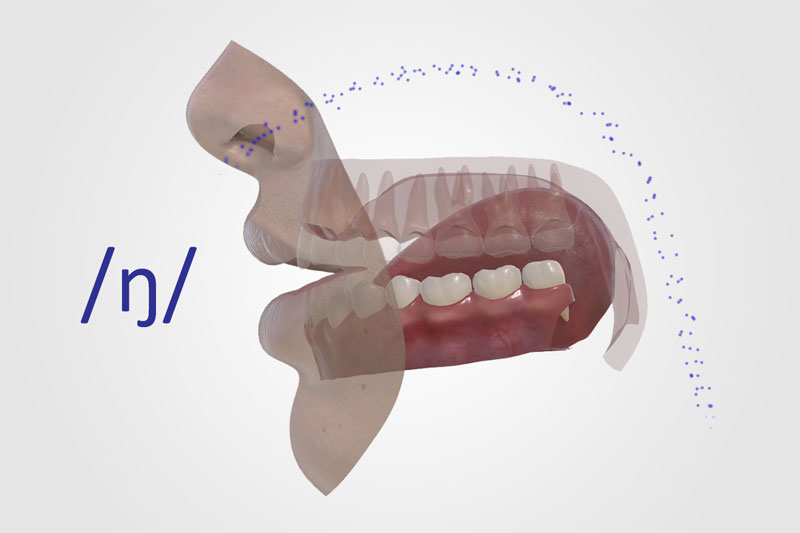
Frequently asked questions
A consonant sound is a speech sound made by partly or completely blocking or restricting airflow as it passes through the vocal tract. This is what sets consonants apart from vowels, where the air flows more freely. The air is usually released through the mouth, but nasal sounds such as /m/, /n/ and /ŋ/ are released through the nose. English has 24 consonant sounds, compared with 21 consonant letters in the alphabet.
English has 24 consonant sounds. Some are written with a single letter, such as /p/ in “pot”, while others are written with letter combinations, such as /ʃ/ in “shut”, /ʧ/ in “church”, /θ/ in “thick” and /ŋ/ in “thing”. This is why consonant sounds do not map neatly onto the 21 consonant letters of the alphabet. You may see larger figures such as 40 or 44 quoted elsewhere; these refer to the total number of speech sounds in English, including vowels, and vary depending on the accent or teaching system being described. The number of consonant sounds is usually given as 24.
Consonant sounds are usually grouped by their manner of articulation, which means how the airflow is shaped or blocked. English has five main types: plosives, such as /p/ and /b/; nasals, such as /m/ and /n/; fricatives, such as /s/ and /f/; affricates, such as /ʧ/ and /ʤ/; and approximants, such as /w/ and /l/. Consonants can also be grouped by where in the vocal tract they are made, known as place of articulation, and by whether the vocal folds vibrate, known as voicing.
The difference is how the air flows. A consonant is made by blocking or restricting airflow as it passes through the vocal tract, while a vowel is made with the air flowing relatively freely, shaped by the position of the tongue, jaw and lips. English syllables are typically built around a vowel sound, with consonants forming the edges. English has 24 consonant sounds. The number of vowel sounds is usually given as around 16 to 20, depending on the accent.
Place and manner of articulation describe two different features of how a consonant is made. Place of articulation is where in the vocal tract the sound is produced, for example at the lips, the teeth or the soft palate. Manner of articulation is how the airflow is shaped or blocked at that place, for example whether it is stopped completely, forced through a narrow gap, or allowed to flow around the tongue. A full description usually combines place and manner with voicing. For example, /t/ is a voiceless alveolar plosive: voiceless is the voicing, alveolar is the place, and plosive is the manner.
Each consonant in the tables above links to a short video showing how that sound is produced. To go further, Pronunciation Coach 3D lets you type any English word or sentence, hear it spoken, and watch an animated 3D model of the mouth showing how the tongue, lips and airflow shape each sound.
The best way to improve is to practise and compare. Pronunciation Coach 3D records your speech and displays it as a waveform alongside an animated 3D model of the mouth, so you can compare your pronunciation with the model. It also gives a speech intelligibility score, showing how clearly your speech was understood.